


Next: Ray-tracing
Up: Introduction
Previous: The visual sense
Contents
Index
The first attempts resulted in what we're calling today a ``local illumination model''. These are widely used in today's PC 3D graphic adapter technology (OpenGL and DirectX are famous software libraries providing 3D graphic primitive operations, mainly polygon-based, with local illumination models).
Local illumination models mainly introduce two simplifications:
- The objects will be rendered isolated from their environment; in the moment of rendering no other objects are taken into account. This results in having no inter-reflections etc. at all!
- Only reflections are taken into account (transparency could be imitated with tricky algorithm, but it remains a fake).
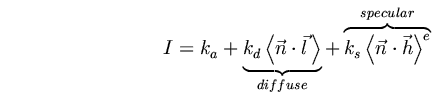
A famous algorithm for local illumination models is Phong's formula describing diffuse and specular reflections:
 |
(1) |
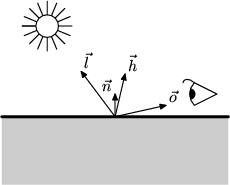
Figure 2:
Vectors in a local illumination model
 |
Equation 1 separates the intensity of the percepted light in
three components:
- ambiental component
- represents the background illumination, i.e. light
being diffused by other objects. You could see it as a very simple approximation for
a radiosity solution (therefore you shouldn't use ambiental components when
using radiosity!). Thus it is represented by the additive ambiental intensity
 .
.
- diffuse component
- represents the reflected light diffused by the rough
microstructure of the surface. Following the observation that the diffuse
component reaches its maximum when the lightsource shones at the surfaces
vertically and its minimum when the rays are in parallel with the surface
its intensity will be approximated by the scalar product of the vector
pointing to the lightsource
 and the norm vector of the surface
 (see fig. 2. The factor
  rules
the strength of the diffuse component as a material property.
rules
the strength of the diffuse component as a material property.
- specular component
- represents the light reflected by even parts of the
microstructure. It will be maximal when the observer position lies in the
path ruled by the reflection law. Therefore we could use the scalar product
of the vector describing the reflected light path (could be calculated by
"mirroring" at ) with the vector
 ; for
computational efficency the scalar product of the norm vector and
a helping vector
; for
computational efficency the scalar product of the norm vector and
a helping vector 
 |
(2) |
will be used instead.
Notice that the separation of reflections into diffuse and specular components
has no physical background!
Equation 1 also shows the importance of the norm vector
 in the lightning calculation; indeed is used to simulate an
uneven surface via bump mapping.
in the lightning calculation; indeed is used to simulate an
uneven surface via bump mapping.
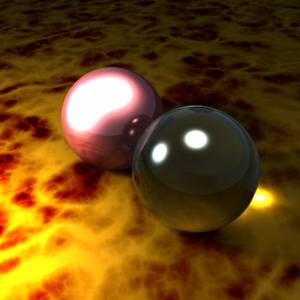
To figure out the disadvantages of local illumination
models have a look at the pictures
3,4,5; they've been
rendered from the same scene, but with pure local illumination
(pic. 3), a global illumination model (whitted-raytracing)
taking global specular interreflections into account
(pic. 4) and a global illumination model (radiosity plus two-way
raytracing) which supports some combinations of diffuse and specular
interreflections (pic. 5).
Figure 3:
pure local illumination
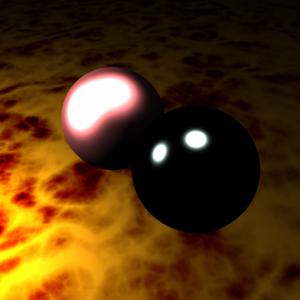 |
Figure 4:
Whitted-Raytracing
 |
Figure 5:
raytracing+radiosity
 |
Notice that the local illumination model doesn't support shadows! If shadows
are required for computer games etc. an additional rendering step has to be
performed (usually following the observation that a shadowed surface isn't
visible from the position of the lightsource drawing the shadow - which lead
to a shadow-zbuffer technique which goes beyound the scope of this document).
Next: Ray-tracing
Up: Introduction
Previous: The visual sense
Contents
Index
Rüdiger Knörig
2002-06-09